
Community Rebuilding Ecosystem Pipeline

A Sustainable Framework for Education, Empowerment, and Community Transformation

Join hundreds of families transforming unused lawns into productive food gardens with professional guidance and ongoing support.

Phase 1: Foundation Building (2023-2025) ✓

Establishing Core Infrastructure and Programs

Achieved Milestones:

• Tye's House 501(c)3 established as foundational non-profit
• Local Food Heroes Program launched at primary training location
• $250,000 USDA Northeast SARE Grant secured for program validation and funding
• FinStead Consulting operational for business development support
• Garden Education Center established at primary site
• Sweet Bulb initial product launch (September 2025) for fundraising
• The Slossberg Squeezery children's business model in development (Winter 2025)
• Strategic partnerships formed with veteran organizations, agricultural experts, and community groups

Phase 2: Agricultural Enterprise Development (2026)

Building Market Farm and Mobile Service Infrastructure

2026-01-01
Q1 2026: Operations Launch at Primary Site

  • Launch full agricultural operations at primary Garden Education Center
  • Select final apprentice candidates for intensive training
  • Begin comprehensive seed starting for season
  • Implement succession planting systems
  • Establish production infrastructure and workflows

2026-04-01
Q2 2026: Training Program Expansion

  • Expand farm operations to full available space
  • Launch monthly workshop series for community education
  • Develop volunteer program infrastructure
  • Continue apprentice hands-on training
  • Build post-harvest handling and processing systems

2026-07-01
Q3 2026: Mobile Service & Market Launch

  • Deploy Local Food Heroes mobile service with Farmers Market season (May)
  • Train graduates in mobile agricultural service delivery
  • Establish service routes aligned with market schedules
  • Implement business tracking systems
  • Complete fall crop planning for extended season production

2026-10-01
Q4 2026: Brand Development & Expansion

  • Establish Sweet Bulb as independent brand (building from Sept 2025 launch)
  • Expand direct-to-consumer sales channels
  • Build restaurant and retail partnerships
  • Create expanded value-added product lines
  • Prepare infrastructure for 2027 program expansion

Phase 3: Housing Initiative Launch (November 2026)

Creating Stable Foundations for Program Participants

November 2026: Planning Phase

• Identify initial property partnerships
• Develop structured community living model
• Create resident selection criteria
• Design agricultural therapy integration with
   Garden Education Center

December 2026 - Q1 2027: Implementation

• Launch first transitional housing location
• Integrate housing residents with agricultural training
• Establish mentorship and support systems
• Create pathways from housing to employment
• Connect residents with hands-on learning opportunities

Phase 4: Community Market Development (Spring 2027)

Expanding Access and Creating Economic Opportunities

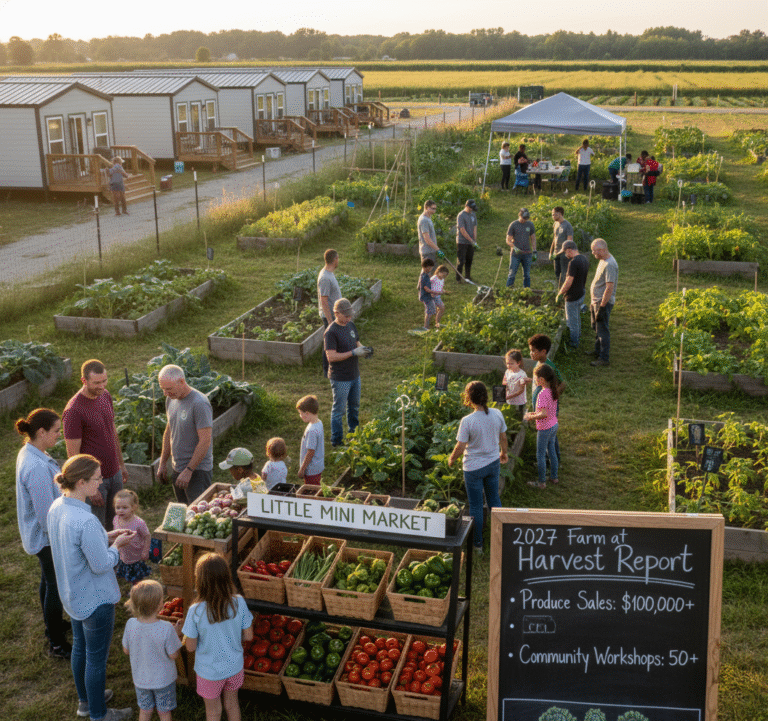
Spring 2027: Little Mini Market & The Farm Launch

• Open Little Mini Market as community retail operation
• Formally launch The Farm at Leslie Court as Garden Education Center
• Feature products from Local Food Heroes graduates
• Create family STEAM agriculture program
• Establish community gathering spaces at both locations
• Launch youth entrepreneurship programs based on Squeezery model

Growing Season 2027: Full Integration

Connect all ecosystem components:
• Veterans completing training → Operating mobile services
• Housing residents → Agricultural employment
• Market farm production → Little Mini Market sales
• Community members → Educational programs at both Garden Education Centers
• Local families → Apprenticeship opportunities at The Farm
• Youth → Business development through proven models

Supporting Infrastructure (Ongoing)

Business Development
(FinStead Consulting)

Continuous Services:
• Marketing support for all initiatives
• Business planning for graduate enterprises
• Grant writing and funding development
(USDA Northeast SARE grant management)
• Digital infrastructure management
Educational Programs

Local Food Heroes Training:
• Regenerative agriculture techniques
• Business development skills
• Mobile service operations
• Market garden management for personal food production

Children's Business Development

The Slossberg Squeezery
Winter 2025/2026 soft launch):
• First children's business model development
• Testing framework for youth entrepreneurship
• Creating vetted model for Little Mini Market youth programs
• Building foundation for 2027 family business initiatives
Garden Education Centers

Primary Training Site: Established flagship location for veteran-focused programs
The Farm at Leslie Court: Future community Garden Education Center (2027 formal launch)
Future Expansion Model: "The Farm at [Location]" replicable framework for families joining the mission

Community Network

Strategic Collaborations:
Veteran service organizations
(training and participant recruitment)
Agricultural education institutions
(expertise and curriculum support)
Local food security organizations
(distribution partnerships)
Faith-based communities
(land access and volunteer resources)
Municipal entities
(community development initiatives)
Success Metrics and Milestones

2026 Goals:

2027 Goals:

Risk Mitigation Strategies

Agricultural Risks

  • Diversified crop selection for value-added products
  • Focus on education reduces production pressure
  • Succession planting for continuous harvest
  • Expert instructor network for support through USDA Northeast SARE grant
  • Future site expansion (The Farm 2027) creates redundancy

Financial Sustainability

  • Multiple revenue streams (training, products, services)
  • USDA Northeast SARE grant funding for program development
  • Sweet Bulb products initially supporting fundraising efforts
  • Social enterprise model for long-term viability
  • Youth business models creating early revenue streams
  • Community investment through hands-on involvement
  • Formal agreements creating clear financial relationships (2027+)

Community Engagement

  • Start small and scale based on success
  • Build strong relationships before formal partnerships
  • Maintain flexibility in program delivery
  • Test models (like The Slossberg Squeezery) before scaling
  • Keep promising participants informed about future opportunities
  • Document and share successes regularly

Integration Points

Each component strengthens the others:

Education → Empowerment

Teaching families to grow their own food creates self-sufficiency

Graduates become service providers and educators

Residents gain foundation for growth
Farm output creates products, not dependency
Children learn entrepreneurship through proven models
Engaged families sustain initiatives
Replicable framework for mission-aligned families (2027+)

Future Vision: The Farm Network (2027+)

The 2027 launch of The Farm at Leslie Court establishes a replicable model where:

Conclusion

This updated timeline reflects our focused approach to building each component systematically. Throughout 2026, we concentrate on establishing full operations at our primary Garden Education Center, graduating our first Local Food Heroes cohort, and launching our first mobile agricultural service operation. Sweet Bulb, launched in September 2025 for fundraising, will develop into an independent brand by Q4 2026.

The Slossberg Squeezery pilot program creates the youth entrepreneurship framework necessary for the Little Mini Market’s family programs in 2027. The November 2026 housing initiative provides crucial stability for program participants while preparing for the 2027 growing season expansion.

The Farm at Leslie Court, while mentioned as part of our future vision, will formally launch in 2027 as a community Garden Education Center, creating a replicable framework for expansion as mission-aligned families join the initiative.

This sequenced approach ensures each element is properly established before the next phase begins, creating a sustainable ecosystem for long-term community transformation through education and empowerment rather than dependency.

This material is based upon work supported by the National Institute of Food and Agriculture, U.S. Department of Agriculture, through the Northeast Sustainable Agriculture Research and Education program under subaward number CNE25-001.

Any opinions, findings, conclusions, or recommendations expressed in this publication are those of the author(s) and do not necessarily reflect the view of the U.S. Department of Agriculture.